Note: Fortivox Home is reader-supported. We may earn an affiliate commission when you click links on this page, at no extra cost to you.
Standing desks solve the all-day sitting problem by creating a new one: standing in a fixed position for hours at a stretch. Anti-fatigue mats reduce the physical toll of prolonged standing, but the market is saturated with cheap foam mats that compress flat within a year and become obstacles rather than tools.
This guide covers the anti-fatigue mats that are genuinely built to maintain their support properties over years of daily use — because a mat that’s lost its resilience is worse than no mat at all.
The Science Behind Anti-Fatigue Mats
The discomfort of prolonged standing comes from static muscle contraction. When you stand in a fixed position, the muscles in your legs, lower back, and feet are constantly engaged to maintain balance — even when you’re not consciously moving. This sustained low-level contraction reduces blood flow and causes the cumulative fatigue that makes prolonged standing uncomfortable.
Anti-fatigue mats reduce this effect through two mechanisms: first, the cushioned surface slightly reduces the impact force transmitted to the joints with each small weight shift; second, the unstable-but-supportive surface encourages small, constant micro-movements that pump blood through the lower extremities.
The second mechanism — micro-movement — is why the best anti-fatigue mats aren’t simply flat foam. The Topo by Ergodriven, the most studied mat in this category, has a topographic surface with ridges and a central dome that encourages constant subtle repositioning without requiring conscious effort.
Material Durability: What Holds Up Over Years
Foam mats (the vast majority of the market below $80) have a fundamental durability problem: compression set. Polyurethane foam undergoes permanent deformation under repeated compressive load. A mat that felt supportive when new will feel noticeably thinner and firmer within 12–18 months of daily use. There is no way to reverse this.
Polyurethane gel mats maintain their support properties longer than foam because gel has better elastic recovery — it returns to its original shape more completely after compression. The better gel mats (Topo, WellnessMats) maintain their support profile for 5–10 years of daily use.
Natural rubber mats are the BIFL choice for durability: natural rubber has excellent elastic recovery and doesn’t off-gas. The WellnessMat Signature Series uses a proprietary polyurethane compound with similar performance to natural rubber.
Look for: density over softness. A denser mat feels firmer initially but maintains its support profile far longer than a soft, thick foam mat that compresses quickly.
Topo by Ergodriven: The Research-Backed Standard
The Topo’s topographic design was developed in response to a genuine insight: the most effective anti-fatigue surface isn’t flat, it’s contoured. The raised central dome, angled foot slopes, and ridge patterns create a surface that naturally encourages micro-movement without requiring the user to think about it.
At $99, the Topo is mid-range in price but top-tier in effectiveness for the specific problem of standing desk fatigue. It’s been in production since 2015, which is a meaningful signal in a category full of brands that appear and disappear within two years.
The material (high-density polyurethane) has held up well in long-term user reports — most Topo owners report maintained support properties at the 3–5 year mark.
The honest caveat: the Topo’s topographic surface is designed for barefoot or minimally-shod standing. Users who stand at their desk in heavy soled shoes may find the surface less effective and should look at flat, high-density alternatives.
WellnessMats: The Premium Tier
WellnessMats occupies the premium end of the market ($150–$250) and for long-term use, the price premium is defensible.
Their Signature Series uses a proprietary polyurethane formulation that the company has been refining since 2003. Long-term users — including commercial kitchen and industrial environments where mats see 12+ hours of daily use — consistently report maintained support properties well beyond the 5-year mark.
WellnessMats offers a lifetime guarantee against compression, cracking, and chipping on their commercial products — a warranty that reflects genuine confidence in the material’s longevity.
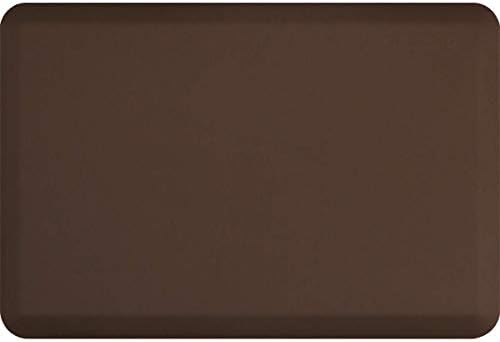
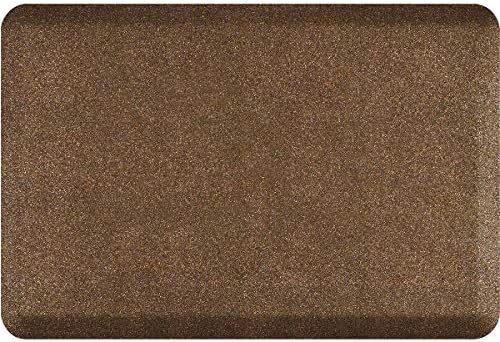
The aesthetic is simpler than the Topo (flat surface with beveled edges) — which is actually an advantage for users who prefer the freedom to stand and shift position however they like without being nudged toward a specific posture by the mat surface.
WHERE TO BUY
| ✦ STAND BETTER, ALL DAY ► Topo by Ergodriven ($109): Best for users who want a mat that actively encourages movement. ► WellnessMats Signature Series ($120+): Best for long-term durability and the cleanest aesthetic.. |