
Note: Fortivox Home is reader-supported. We may earn an affiliate commission when you click links on this page, at no extra cost to you.
There is a category of desk accessory that straddles the line between tool and object — things that earn their place on the desk both by doing their job well and by looking like they were placed there deliberately. These are the objects that appear in the background of magazine shoots and perfectly styled workspace photographs, and they look that way not because they’re purely decorative but because the people who made them understood that usefulness and beauty are not in tension.
This guide is for that category specifically. Everything here has a genuine function. Everything here is also worth looking at.
The Principle Behind Beautiful Function
The objects that age best on a desk — the ones that look better in five years than they did when they arrived — share a design philosophy that prioritizes material honesty. The material the object is made from is visible, not hidden. Wood grain shows. Leather patinas. Metal develops a lived-in quality. There are no surfaces trying to look like something they’re not.
This is also the principle behind BIFL purchasing more broadly: objects that reveal their materials age beautifully, because the aging of natural materials reads as character. Objects that conceal their materials under paint, laminate, or plating age poorly, because the concealment degrades and reveals the lie.
The following picks are organized by material family rather than function category — because the material is the primary decision.
Leather Objects Worth Owning
Full-Grain Leather Desk Pad — The Anchor Piece
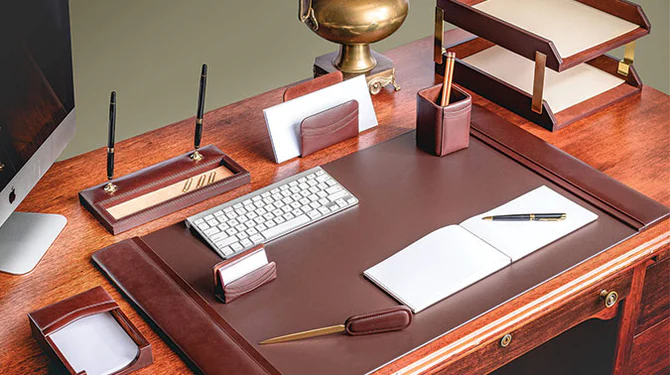
The desk pad is the single highest-impact aesthetic purchase for a home office desk. A full-grain leather pad in cognac covers the entire working surface in a warm, rich material that frames every other object on the desk and develops a distinctive patina from daily handling. The hand-stitched edge detail is visible at close range and communicates the craft intent of the piece.
The cognac colorway works in virtually any material palette — it’s warm enough to complement walnut and brass, neutral enough to sit comfortably on a white or light oak surface, and rich enough to anchor a dark navy or dark wood desk. The black colorway is the right choice for minimal or industrial palettes.
Rovelis, a new brand that just launched on Amazon fits the BIFL criteria exactly. Genuine leather in cognac colorway, hand-stitched edges, perfect size for your home office desk.
Leather Catch-All Tray — The Detail That Rounds Off a Desk
A small leather tray — 6″ to 8″ square — positioned at the corner of a desk creates a dedicated landing zone for the objects that otherwise scatter: phone face-down, AirPods, a ring removed before typing, a pen. It’s a functional object that happens to look like something you’d find on a very well-appointed desk in a very good hotel.
What to look for: the same material hierarchy that applies to desk pads. Full-grain leather, visible stitching at the corners, a base that won’t slip on the desk surface. Avoid bonded leather trays — the edges delaminate within two years of daily handling. Korchmar and Levenger both make leather desk trays in the correct quality tier; Grovemade makes a leather catch-all tray in vegetable-tanned leather that is perhaps the best combination of material quality and design restraint available.
Leather Notebook Cover — The Analog Tool That Stays
In a workspace built around premium materials, a cheap spiral-bound notebook is a jarring object. A leather notebook cover — designed to hold a standard A5 or Field Notes-size notebook, with a pen loop — converts a disposable paper product into a permanent tool. The notebooks themselves are replaceable. The cover develops patina and stays.
Bellroy, Dodocase, and Midori all make leather notebook covers in the correct quality tier. The Bellroy Notebook Cover A5 is the most elegantly designed and most BIFL-appropriate at $79 — it accommodates Leuchtturm1917 and Moleskine notebooks, which themselves represent a significant upgrade from spiral-bound pads.
Wood Objects Worth Owning
Solid Wood Pen Cup — The Detail That Signals Intention
A solid walnut or oak pen cup is the desk accessory that most clearly signals design intentionality, because it’s an object for which there are obvious cheap alternatives (plastic, acrylic) that would function identically. Choosing the walnut version communicates that the function wasn’t the only consideration.
Grovemade’s walnut pen cup ($35) is the benchmark: solid walnut, hand-turned, with a weighted base. It holds exactly the right number of pens (four to six) without becoming a catchall for markers, scissors, and USB cables that belong elsewhere. The grain on each cup is unique because solid wood is unique.
Wooden Desk Clock — The Analog Object That Earns Its Presence
A desk clock is one of the few analog objects that remains genuinely useful in a workspace full of digital devices — checking the time from a clock on the desk doesn’t require waking a phone screen and risking a notification distraction. The object case for a desk clock is strongest when the clock itself is worth looking at.
Cloudnola makes design-forward wooden clocks in beech and walnut that function as small sculptural objects on a desk. The Frame Clock ($89) and the Stack Clock ($75) are both clean geometric forms that look intentional without looking like office supply store accessories. Battery-operated, no wires, and the solid wood construction means they’re not going anywhere.
Wooden Book Ends — Structure and Object Simultaneously
Bookends for a home office desk or shelf do double duty: they hold books upright (functional) and they’re among the most visible objects on the surface when books are between them (aesthetic). Solid wood bookends — walnut, oak, or maple — with a minimal geometric form are essentially timeless objects that look as appropriate today as they will in 20 years.
Grovemade’s walnut bookends ($55) are the right choice for a design-forward desk. Cast iron bookends in matte black are the correct choice for a more industrial palette. Avoid brass or gold-toned metal bookends — they tend to lean toward an aesthetic that can date more quickly than wood.
Metal Objects Worth Owning
Brass Letter Opener — The Object That Is Entirely About Beauty
A letter opener is perhaps the best example of an object whose primary justification in a modern office is aesthetic rather than practical. Email has reduced physical mail to a fraction of what it was 20 years ago. But a solid brass letter opener on a leather tray on a walnut desk is a design statement about the quality of the tools in this space that communicates the same thing a quality pen or watch communicates: that the person at this desk cares about the objects around them.
Craighill’s Anza Letter Opener ($75, solid brass) is the definitive version of this object: a single folded form in solid brass that develops a warm patina with handling. It’s been in their catalog for years without design revision, which is the design world’s equivalent of a product saying ‘I don’t need to be updated because I was right the first time.’
Stainless Steel Ruler — The Tool Disguised as an Object
A quality stainless steel ruler on a desk reads as both precision tool and design object. The Midori Aluminum Ruler ($22) and the Carl Mertens stainless ruler ($45) are both objects that look at home on a considered desk. The stainless steel’s reflectivity catches and moves light differently than the matte surfaces around it, creating visual contrast without introducing a new color.
Matte Black Scissors — The Object That Completes the Tool Set
Scissors belong on a desk. Cheap scissors look like they belong in a junk drawer. Allex matte black scissors ($55) are Japanese-manufactured, precise enough for detailed cutting, and finished in a matte black oxide treatment that reads as entirely intentional on a minimal desk. They’ve been produced without design change for years and are available in stationery shops internationally — a signal of lasting relevance.
Ceramics and Natural Objects
A Single Ceramic Object — The Handmade Counterpoint
In a desk composed primarily of manufactured goods — even high-quality ones — a single handmade ceramic object provides a counterpoint of human irregularity that no machined or cut object can provide. This might be a small ceramic tray for a ring and a pair of earbuds, a ceramic pen cup from an independent maker, or a small vase with a single stem.
The specification: a neutral glaze (cream, warm white, matte black, earth tones) in a simple form. The value here is in the material’s inherent uniqueness — two handmade ceramic pieces are never identical, which means the object on your desk is specifically yours in a way that a manufactured product can’t be.
Sources: Etsy has become a reasonable market for small-batch ceramic makers. Search for ‘handmade ceramic desk tray’ or ‘stoneware pen cup’ and filter by US sellers with strong reviews. Budget $40–$80 for something genuinely handmade versus $15–$20 for something machine-produced and marketed as handmade.
✦ WHERE TO SHOP
► Rovelis Genuine Leather Desk Pad
► Grovemade (walnut pen cup, bookends, leather catch-all tray). American workshop quality. Designed as a cohesive system.
► Craighill (Anza letter opener, Manhattan tray). American-made, small-run production.
► Moleskin Leather Notebook cover
► Design Within Reach (Anglepoise lamps, premium desk accessories)
► Complete the look with some functional accessories: Allex Scissors and Midori Stationery. Shop on Amazon.


